
how to build a deck in tcg games is less about finding a “perfect list” and more about building a plan you can execute under pressure. If your deck feels inconsistent, loses to the same matchup repeatedly, or floods/bricks at the worst time, that’s usually a construction problem, not a “bad luck” problem.
This matters because TCGs reward repetition: you play dozens of games, small percentage points add up, and the strongest decks tend to be the ones that do the same strong thing more often than the opponent can stop it. A competitive list is basically a reliability machine.
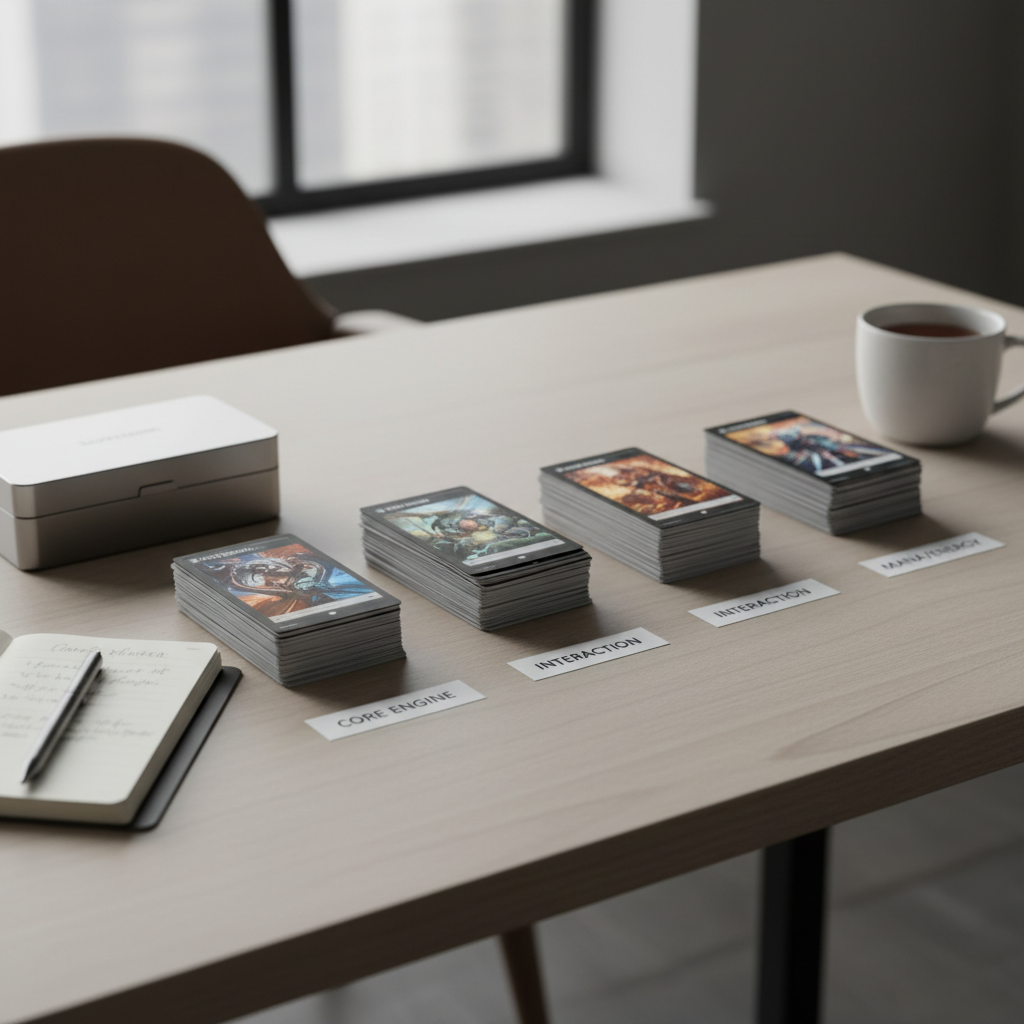
One quick clarification before we dive in: “competitive” does not always mean “expensive.” Many formats allow budget builds that still perform, but you do need discipline around a win condition, card roles, and testing. That’s what this guide focuses on.
Start with a win condition, not a pile of good cards
Most decks that feel weak share a pattern: they contain lots of individually strong cards, but no clear path to closing games. Competitive deckbuilding starts by defining what “winning” looks like, then choosing cards that make that outcome more frequent.
Try to write your win condition in one sentence. Examples might sound like “assemble two pieces and win in one turn,” “build a board and protect it for two turns,” or “trade resources until my inevitability engine takes over.” If you can’t say it plainly, the deck usually can’t do it consistently.
- Primary plan: the most common way you expect to win.
- Backup plan: what you do when your main line is disrupted.
- Time horizon: do you want to win early, midgame, or late?
According to Wizards of the Coast, “BREAD” (Bombs, Removal, Evasion, Aggro, Duds) is a helpful heuristic for Limited. It’s not a full competitive blueprint for every format, but it highlights a useful mindset: prioritize cards that directly influence winning and losing, not just cards that look cool.
Pick an archetype and commit to its priorities
When people ask how to build a deck in tcg games, they often get stuck in the middle, their list tries to aggro and control at the same time. Archetypes are not labels for content creators, they’re decision rules.
Use these as practical guardrails:
- Aggro: lower curve, high redundancy, minimal dead draws, pressure before opponents stabilize.
- Midrange: flexible threats, efficient interaction, plans for both faster and slower decks.
- Control: answers density, card advantage, inevitability finisher, strong sideboard mapping.
- Combo: tutoring/draw smoothing, protection, and clear lines against disruption.
- Tempo: cheap threats plus disruption, win by keeping opponents off-balance.
A simple litmus test: if your deck needs to hit land drops and cast 5-drops to function, don’t fill it with cards that only matter on turn one. Conversely, if you want to end games quickly, don’t pack your deck with “eventually” cards.
Use role-based slots to keep your list honest
One of the most practical ways to build competitively is to assign every card a job. This is where “goodstuff” piles usually fall apart: too many cards are “nice to have,” not “must draw.”
Start with rough slot targets, then adjust based on your format and deck speed:
| Role | What it does | Common symptoms if you’re short |
|---|---|---|
| Win condition / Finishers | Ends the game reliably | You “almost” win, then run out of gas |
| Engine / Value | Card draw, recursion, resource advantage | Topdeck mode too early |
| Interaction | Removal, counters, disruption | Lose to single threat or combo piece |
| Consistency | Tutors, search, filtering, extra copies | Inconsistent openers, “never draw X” |
| Mana/Energy base | Lands, ramp, fixing, resource cards | Color screw, can’t double-spell on curve |
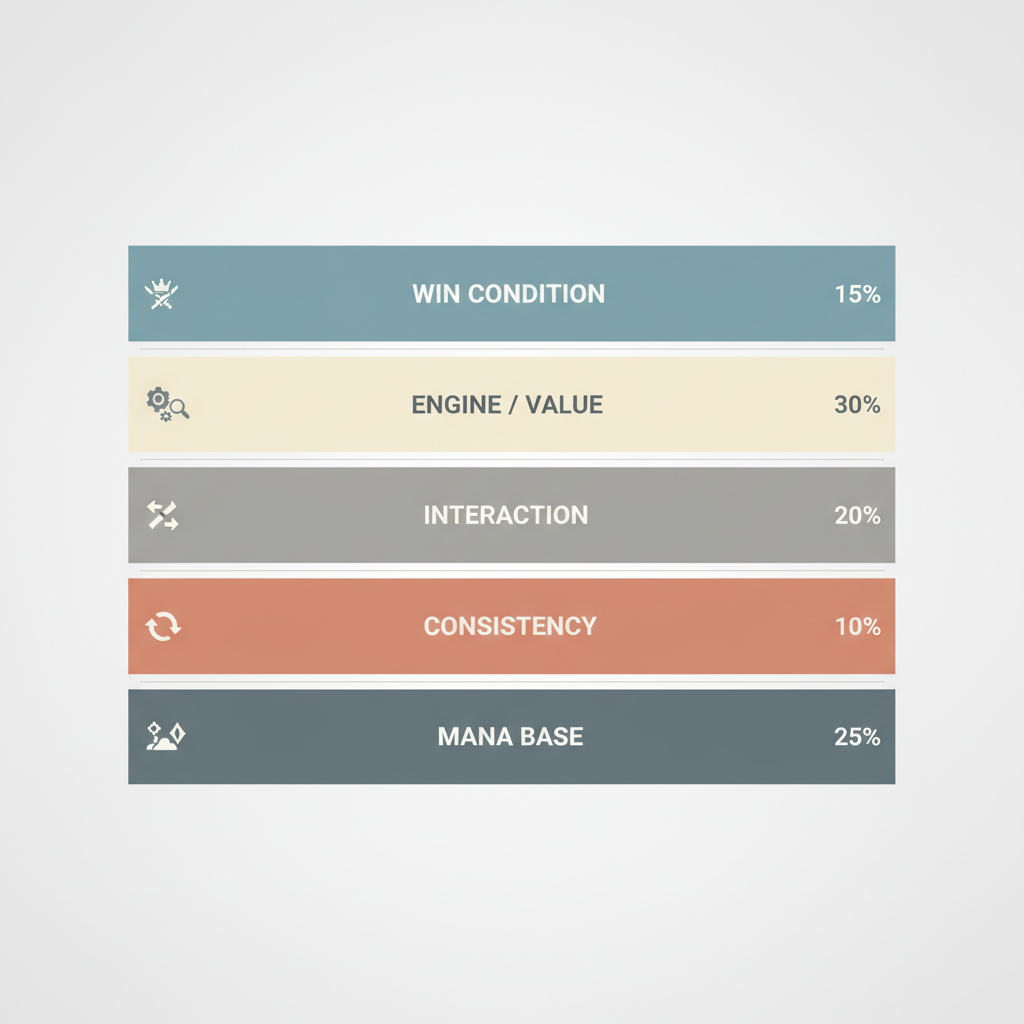
Now do something slightly uncomfortable: if a card doesn’t clearly fit a role, it’s on probation. You can keep a couple of “spice” slots, but competitive lists usually limit those to avoid drawing awkward halves of ideas.
Build for consistency: curve, ratios, and redundancy
Consistency is where many players feel the difference between “fun deck” and “tournament deck.” You don’t need to memorize universal ratios, but you do need to engineer your opening hands to behave.
Curve and early plays
Whatever your game’s resource system, you want meaningful actions early. If your deck often passes turns 1–2 doing nothing, you’re donating tempo. For slower decks, “meaningful” can be setup, filtering, or interaction, not just threats.
- Count your keepable hands: goldfish 20 opening hands, note how many are functional.
- Watch for clumps: too many 4–6 cost cards is a classic brick pattern.
Redundancy beats uniqueness
If your strategy hinges on seeing a specific effect, you usually want multiple ways to access it: extra copies, search, draw, or functional reprints. That’s a core answer to how to build a deck in tcg games without relying on luck.
Resource base as a competitive edge
Players often spend hours tuning spells and ignore the resource base, then wonder why games feel unplayable. If your format uses lands, energies, inks, or similar, treat that part as the deck’s foundation.
- Track how often you miss early resource drops.
- Track how often you have the wrong colors/types to cast key cards.
- Improve fixing before you upgrade “cool” cards.
According to Pokémon Organized Play resources, consistency cards and search effects are a major reason top lists function smoothly across many rounds. Different games express this differently, but the principle carries.
Test with intent: a small loop that actually improves the list
Playtesting can waste time if it’s just “jam games and vibe.” Competitive testing is a loop: set a question, gather notes, change one thing, repeat. This is where your deck becomes predictable in a good way.
Use a simple, repeatable loop:
- Step 1: pick one matchup or one problem (e.g., “I lose to flyers,” “I flood,” “combo disrupts me”).
- Step 2: play 5–10 focused games, tracking what mattered (not every detail).
- Step 3: change 3 cards or fewer per iteration so you learn cause and effect.
- Step 4: re-test the same scenario.
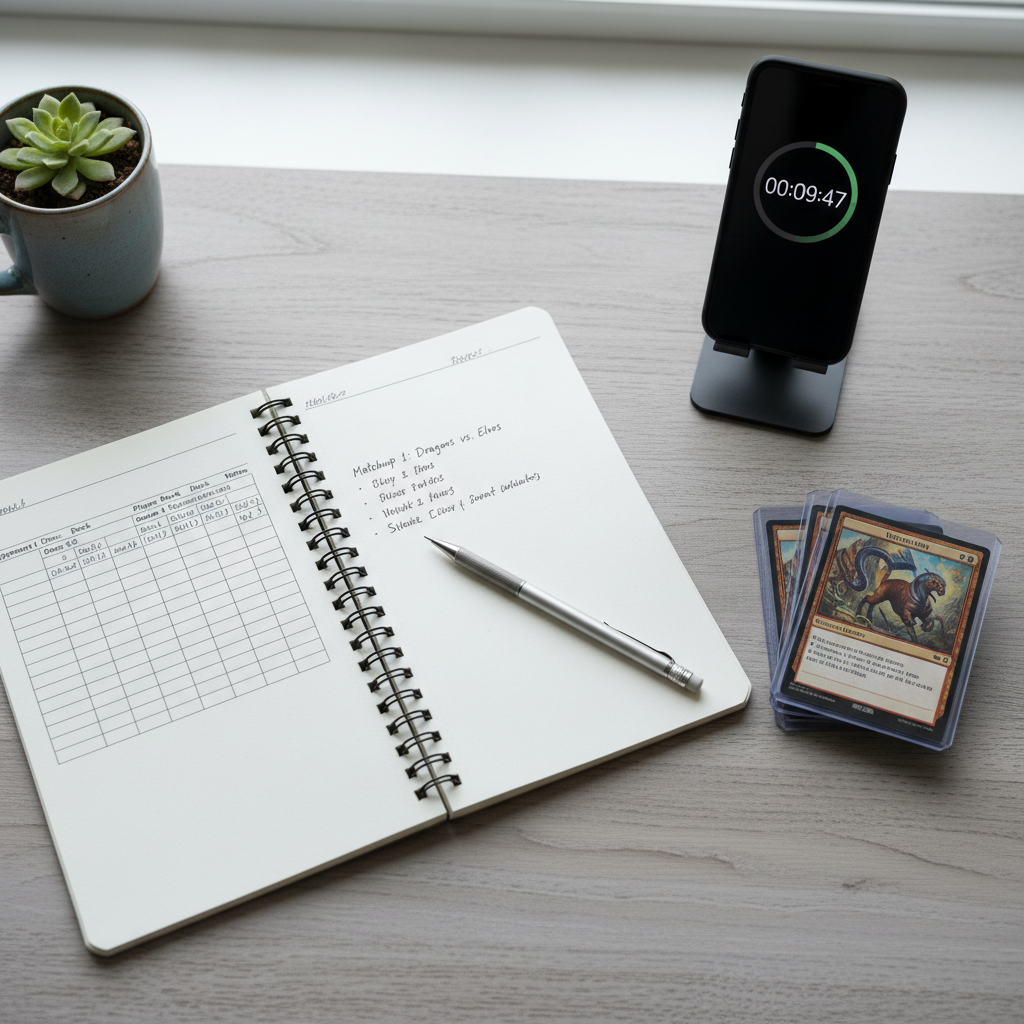
What to write down so it’s useful later:
- How you lost: tempo, resource screw, ran out of answers, couldn’t close, etc.
- Which cards were stuck in hand most often.
- Which cards you wanted to draw but rarely saw.
- Whether sideboard swaps improved the matchup or just “felt” good.
Many players discover a tough truth here: their “pet card” is fine, it’s just not doing a job often enough. Competitive decks are a little ruthless.
Sideboard and flex slots: plan for real opponents
If your format has a sideboard, treat it as part of deckbuilding, not an afterthought. The best sideboards are not 15 random hate cards, they’re a map: “When I see X, I become Y.”
Build a sideboard map
- List the top 5 decks you expect to face.
- For each matchup, note 3–6 cards to bring in and 3–6 to take out.
- Keep your plan coherent, don’t dilute your win condition.
Format without sideboards
If you play best-of-one formats, you still have “flex slots.” Those are your main-deck answers to common problems, but you can’t overdo it. If you stuff too many situational cards, consistency drops.
Self-check: are you building competitive, or just collecting ideas?
If you want a quick diagnostic, run through this list. Be honest, it saves time.
- I can explain my win condition in one sentence.
- My deck has enough early plays to avoid falling behind for free.
- Every card has a role, and I can justify it beyond “it’s strong.”
- I have redundancy for key effects, not single points of failure.
- I track testing notes and change only a few cards at a time.
- My resource base supports my curve, not the other way around.
If you checked fewer than four, that’s not a moral failing, it just means you’re still in the “prototype” stage. That’s normal, now you know where to tighten.
Common mistakes that quietly kill win rate
These issues are boring, which is exactly why they persist. And yes, they show up across games, even when card rules differ.
- Over-teching: cramming answers for everything, then drawing the wrong half of your deck.
- Too many one-ofs: “I like options” often translates to “I like inconsistency.”
- Ignoring sequencing: a deck may be fine, but your curve demands tighter play patterns than you expect.
- Chasing meta noise: rebuilding weekly because you saw one list online, without confirming your local field.
- Cutting lands/resources too far: winning one game while mana-screwed doesn’t prove the cut was correct.
According to the Magic: The Gathering Judge Program and official tournament guidance, clear decklists and consistent game actions matter for competitive play; that culture tends to reward decks that minimize avoidable variance.
Practical build process you can reuse (even on a budget)
If you want a repeatable method for how to build a deck in tcg games, this workflow tends to hold up across formats:
- Step A: choose a win condition and archetype.
- Step B: draft a “roles” skeleton (engine, interaction, consistency, resources, finishers).
- Step C: fill with redundant effects, keep spice slots limited.
- Step D: fix the resource base to support your curve.
- Step E: test with one question at a time, adjust small.
- Step F: create a sideboard or flex plan for top matchups.
Budget tip that’s usually worth it: spend money on consistency pieces and resource base upgrades before premium finishers. Many decks win because they “do the thing” more often, not because the finisher is flashier.
Wrap-up: build a plan you can repeat
A competitive deck is a set of repeatable decisions: your win condition stays clear, your roles stay balanced, and your testing creates small improvements instead of random churn. If you take one action today, write your one-sentence win condition and then cut any card that doesn’t help you reach it.
If you take a second action, run 20 opening-hand checks and note how many are truly keepable. That single exercise often reveals more than hours of arguing about card choices.
FAQ
What’s the fastest way to learn how to build a deck in tcg games without copying a list?
Copying a list can teach you staples, but you learn faster by copying the structure: win condition, role slots, and a testing loop. Start from a known archetype, then change only a few cards and track results.
How many “tech” cards should I run for a bad matchup?
Enough to see them when they matter, but not so many that they rot in hand elsewhere. In many formats, 2–4 copies of a flexible answer (or a small sideboard package) tends to be more reliable than a single silver bullet.
Why does my deck feel inconsistent even with strong cards?
Usually it’s curve, redundancy, or resource base. Strong cards don’t help if you can’t cast them on time or if your deck needs a specific effect you only run once.
Should I prioritize card draw or removal?
It depends on archetype. Aggro often wants efficient threats and a bit of interaction, while control typically needs higher answer density plus draw to keep up. If you don’t know, start balanced, then adjust based on what you lose to most often.
How do I know if I should mulligan more aggressively?
If your deck relies on early setup or specific colors/resources, conservative keeps can lose quietly. Track your opening hands: if “keepable” hands still lead to non-games, you may need more consistency pieces or a tighter mulligan plan.
What’s a good way to practice without constant ladder grinding?
Goldfish your first three turns, practice common lines, and do short targeted sets against one matchup. Intentional reps beat random volume when you’re tuning a list.
When should I ask for help from a coach or competitive community?
If you’ve tested multiple iterations and still can’t identify why you lose, outside eyes help. Bring a clear decklist, matchup notes, and what you already tried, you’ll get better feedback than “rate my deck.”
If you’re trying to tighten a list for locals or a bigger event and you’d rather not guess, sharing your deck’s win condition, role counts, and a few matchup notes with a competitive community can be a more efficient next step than swapping cards at random.